NASA
is on a journey to Mars, with a goal of sending humans to the Red
Planet in the 2030s. That journey is already well under way.
For decades, the agency and its partners have sent orbiters,
landers and rovers, dramatically increasing our knowledge about the Red
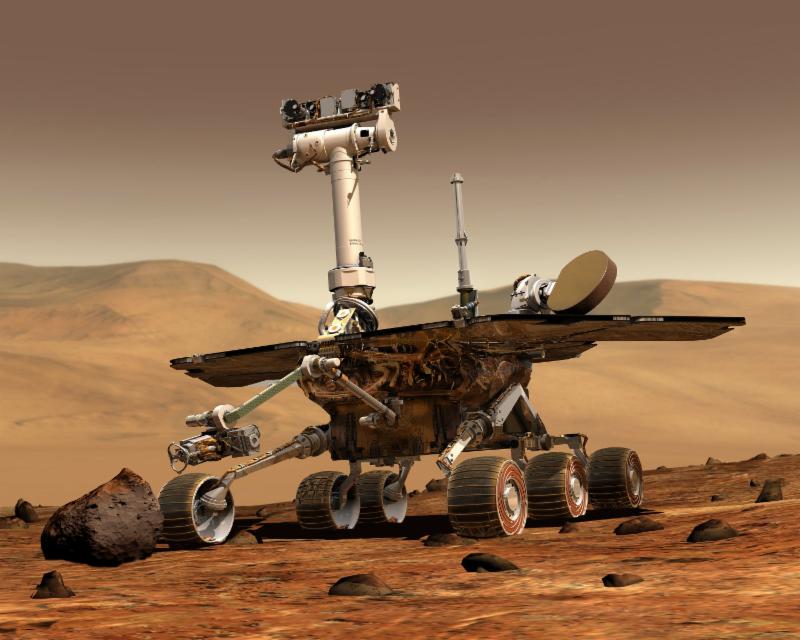
Planet and paving the way for future human explorers. The Curiosity
rover has gathered radiation data to help us protect future astronauts,
and the upcoming Mars 2020 rover will study the availability of Martian
resources, including oxygen.
There is more to learn as we expand humanity's presence into the
solar system: Was Mars once home to microbial life or is it today? Can
it be a safe home for humans? What can the Red Planet teach us about our
own planet's past, present and future?
Building on the robotic legacy, the human exploration of Mars
crosses three thresholds, each with increasing challenges as humans move
farther from Earth: Earth Reliant, the Proving Ground, and Earth
Independent.
Earth Reliant exploration is focused on research
aboard the International Space Station. The orbiting microgravity
laboratory serves as a world-class test bed for the technologies and
communications systems needed for human missions to deep space.
Astronauts are learning about what it takes to live and work in space
for long periods of time, increasing our understanding of how the
body changes in space and how to protect astronaut health.
We're also working with our commercial crew and cargo partners to
provide access to low-Earth orbit and eventually stimulate new economic
activity, allowing NASA to continue using the station while preparing
for missions beyond.
Next, we move into the Proving Ground, conducting a
series of missions near the moon -- we call it "cislunar space"
-- that will test the capabilities we will need to live and work at
Mars. Astronauts on the space station are only hours away from Earth,
but the proving ground is days away, a natural stepping stone to a Mars
mission, which will be months away from home.
The first of these missions will launch NASA's powerful new rocket,
the Space Launch System, from NASA's Kennedy Space Center in Florida.
The mission will carry the Orion spacecraft (without astronauts)
thousands of miles beyond the moon during an approximately three week
mission.
Next up, astronauts will climb into Orion for a similar mission, traveling farther than humans have ever traveled before.
Also in the 2020s, we'll send astronauts on a yearlong mission into
this deep space proving ground, verifying habitation and testing our
readiness for Mars.
Another proving ground milestone is the Asteroid Redirect Mission.
NASA will send a robotic spacecraft to capture an asteroid boulder and
put it in a safe orbit around the moon. Astronauts on Orion will then
explore the asteroid, returning to Earth with samples. This two-part
mission will test both deep space spacewalking and sampling techniques
and Solar Electric Propulsion, which we'll need to send cargo as part of
human missions to Mars.
Finally, we become Earth Independent, building on what we've learned on the space station and in deep space to send humans to low-Mars orbit in the early 2030s.
This phase will also test the entry, descent and landing techniques
needed to get to the Martian surface and study what's needed for
in-situ resource utilization or "living off the land." NASA is already
studying potential "Exploration Zones" on Mars that would offer
compelling science research and provide resources our astronauts can
use.
Science missions are already in the Independent phase, with the
next rover due in 2020. We will also conduct a round-trip robotic
demonstration mission with sample return in the late 2020s.
Mars is the next tangible frontier for human exploration, and it's
an achievable goal. There are challenges to pioneering Mars, but we know
they are solvable. We are well on our way to getting there, landing
there, and living there.










 Journey To Mars


 New Flu Information for 2017-2018
 Identity Theft Protection Service For RAUS Members