|
|
|
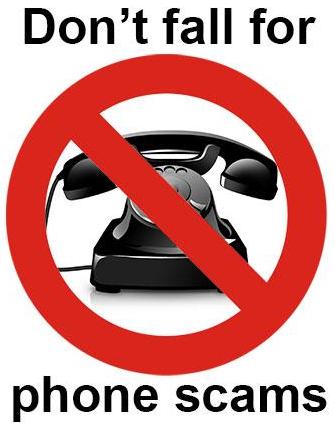 Phone Scams From ftc.gov Every year, thousands of people lose money to telephone scams - from a few dollars to their life savings. Scammers will say anything to cheat people out of money. Some seem very friendly - calling you by your first name, making small talk, and asking about your family. They may claim to work for a company you trust, or they may send mail or place ads to convince you to call them.
If you get a call from someone you don't know who is trying to sell you something you hadn't planned to buy, say "No thanks." And, if they pressure you about giving up personal information - like your credit card or Social Security number - it's likely a scam. Hang up and report it to the Federal Trade Commission.
Signs of a Scam
Often, scammers who operate by phone don't want to give you time to think about their pitch; they just want you to say "yes." But some are so cunning that, even if you ask for more information, they seem happy to comply. They may direct you to a website or otherwise send information featuring "satisfied customers." These customers, known as shills, are likely as fake as their praise for the company.
Here are a few red flags to help you spot telemarketing scams. If you hear a line that sounds like this, say "no, thank you," hang up, and file a complaint with the FTC:
- You've been specially selected (for this offer).
- You'll get a free bonus if you buy our product.
- You've won one of five valuable prizes.
- You've won big money in a foreign lottery.
- This investment is low risk and provides a higher return than you can get anywhere else.
- You have to make up your mind right away.
- You trust me, right?
- You don't need to check our company with anyone.
- We'll just put the shipping and handling charges on your credit card.
|
 |
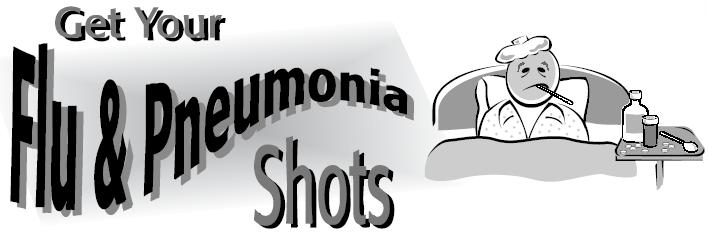 Seniors: Get the Pneumonia Shots Seniors: Get the Pneumonia Shots
From healthfinder.gov
If you are age 65 or older, ask your doctor for shots (vaccines) to help protect you from pneumonia ("noo-MOHN-yah"). Younger people with certain health conditions also need these shots.
What is pneumonia?
Pneumonia is an infection of the lungs that can cause a high fever, cough, and trouble breathing. It can sometimes lead to death, especially in older adults.
The good news is that you can protect yourself from a common type of pneumonia by getting the pneumonia shots.
Visit these websites to learn more:
Which shots protect me from pneumonia?
You need to get 2 shots - called pneumococcal ("noo-muh-KOK-uhl") shots - to prevent pneumonia caused by certain bacteria.
- The first shot is called PCV13.
- The second shot is called PPSV23, and you'll need to get it 6 to 12 months after you get the first shot.
Most people only need to get each of these shots once.
Who needs to get the pneumonia shots?
If you are age 65 or older, get the pneumonia shots.
If you are younger than age 65, it's a good idea to get these shots if you:
- Have a weakened immune system (from cancer or HIV, for example)
- Have a health condition like diabetes, heart disease, or asthma
- Smoke
Find out more about the pneumonia shots. |
|
|
Renew Memberships Online
At the request of our members, RAUS is pleased to provide the ability to renew their membership online and pay by credit or debit card. Just go to our website at www.raushome.com and click on the Online Dues Renewal button. If you are considering converting to a Lifetime Membership, click on the Membership button and select Life Membership.  
|
|
 IRS Phone Scams IRS Phone Scams
Watch out for scams as the tax filing season nears an end.
The Internal Revenue Service issued a warning for consumers about phone scams that are increasingly common.
The IRS says it will always send taxpayers a written notification of any tax due through U.S. mail. It never asks for credit or debit card numbers or prepaid card information over the phone.
Recent scams have targeted immigrants, and threatens them with deportation, arrest, and more. The IRS says potential victims are told they are entitled to large refunds, or that they owe money to the IRS.
Other common characteristics of these schemes include:
- Use of fake names and IRS badge numbers. Those running the schemes generally use common names and surnames to identify themselves.
- Those running the scheme may be able to recite the last four digits of a victim's Social Security number.
- The scheme can spoof the IRS toll-free number on caller ID to make it appear that it's the IRS calling.
- In some cases, a bogus IRS emails is sent to some victims to support bogus calls.
- Victims hear background noise of other calls being conducted to mimic a call site.
- After threatening victims with jail time or driver's license revocation, the callers hang up and others soon call back pretending to be from the local police or DMV, and the caller ID supports their claim.
|
|
 Keep Us Accurate Keep Us Accurate
To be sure your benefits are properly recorded, please advise the association when you change your name or address. If you receive inaccurate membership cards or other correspondence, we want to know. We do not mind reissuing membership cards. |
|
Get Your Eyes Examined
From healthfinder.gov
Have your eyes tested (examined) regularly to help find problems early, when they may be easier to treat. The doctor will also do tests to make sure you are seeing as clearly as possible.
How often you need an eye exam depends on your risk for eye disease. Talk to your doctor about how often to get your eyes tested.
Get an eye exam every 1 to 2 years if you:
- Are over age 60
- Are African American and over age 40
- Have a family history of glaucoma
- People with diabetes need eye exams more often.
- If you have diabetes, get your eyes tested at least once a year.
What happens during an eye exam?
- The doctor will ask you questions about your health and vision.
- You will read charts with letters and numbers so the doctor can check your vision.
- The doctor will do tests to look for problems with your eyes, including glaucoma.
- The doctor will put drops in your eyes to dilate (enlarge) your pupils. A dilated eye exam is the only way to find some types of eye disease.
Am I at risk for a vision problem?
As you get older, your eyes change. This increases your chance of developing a vision problem. You may be at higher risk if one of your parents had a vision problem, like needing to wear glasses.
Common vision problems are:
- Nearsightedness - when far away objects are blurry
- Farsightedness - when far away objects are easier to see than near ones
- Astigmatism - a condition that makes it hard to see fine details
- Presbyopia ("prez-bee-OH-bee-uh") - problems seeing things up close
Am I at risk for eye disease?
Getting older increases your risk of certain eye diseases. You may be at higher risk if you have diabetes or high blood pressure - or if you have a family member with diabetes or an eye disease.
Eye diseases like glaucoma can lead to vision loss and blindness if they aren't caught and treated early.
Depending on your age and medical history, the doctor may look for eye problems that are common in older adults, including:
- Cataracts
- Glaucoma
- Age-related macular degeneration (or AMD)
- Diabetic eye disease
- Low vision
|
|
 Identity Theft Protection Service For RAUS Members Identity Theft Protection Service For RAUS Members
AllClear ID is the technology leader in the identity protection and credit monitoring market. The patented identity protection technology developed by AllClear ID makes it simple for you to protect your identity, and easy to take action if your personal information is compromised. RAUS members will enjoy a 20% discount off the regular monthly rate.
Just go to our website at www.raushome.com and click on the Discounts button and select Technology & Security. From there, go to the AllClear ID login page and input the following Activation Code: "raus". This will allow you to register and receive the discounted rate. |
|
Membership Dues
| AGE RANGE | LIFE DUES | | 40 or less | $325 | | 41 to 45 | $300 | | 46 to 50 | $275 | | 51 to 55 | $250 | | 56 to 60 | $225 | | 61 to 65 | $200 | | 66 to 70 | $175 | | 70 and up | $100 |
 Annual dues are $15 per year. Discounts apply for multiple year memberships: 3 years for $37 and 5 years for $60. Like memberships are available based on the age of the member at the time of the Life conversion. A Life Membership is exempt of dues increase and covers both the member and the spouse. |
|
About RAUS
We are a non-political military association organized in 1970 to secure quality benefits for our members at rates only available to groups. Qualified retired and active members of the United States armed forces and related departments may join.
Membership benefits include discounts and perks, self-help and financial calculators, time-savings and educational resources, along with TRICARE Supplement, CHAMPVA Supplement and other insurance products.
RAUS is partnering with other organizations to establish a long term win-win relationship based on mutual benefits and information available to military families.
For more information, visit our website at www.raushome.com.

RAUS Eligible Defense Departments
* AIR FORCE * ARMY * MARINES * NAVY * NATIONAL GUARD *
* COAST GUARD * NOAA * CIVIL AIR PATROL *
* PUBLIC HEALTH SERVICE * COASTAL & GEODETIC SURVEY *
* ACTIVE & RETIRED * OFFICERS & ENLISTED *
|
|
|
Sincerely,

DONALD T. RUCK, President Retired Association for the Uniformed Services, Inc.
Back To Top |
|
|